Insights & how-tos for smarter financial decisions
Short posts and guides written for busy owners — fast reads with real actions. Topics include tax tips, bookkeeping best practices, growth planning, and product updates.
How to Calculate Your Business's Break-Even Point and Use It to Improve Profitability
Running a profitable business requires more than generating sales. You need to understand how much revenue your company must earn to cover its expenses, when additional sales begin contributing to profit, and how changes in costs affect your financial performance.
One of the most useful tools for answering these questions is a break-even analysis.
For small business owners, understanding your break-even point can help you evaluate pricing, control expenses, plan for growth, and make more informed financial decisions. Rather than relying on assumptions about profitability, you can establish measurable revenue targets based on your actual costs.
Here's how to calculate your business's break-even point and use that information to improve your financial strategy.
What Is a Break-Even Point in Business?
Your break-even point is the level of sales at which your total revenue equals your total costs. At this point, your business is covering its expenses but has not yet generated a profit.
When sales exceed your break-even point, additional revenue can contribute to profitability. When sales fall below it, your business may operate at a loss.
Understanding this number helps answer several important questions:
How much revenue does my business need each month?
How many products or services must I sell to cover expenses?
Are my current prices supporting profitability?
How would hiring employees or increasing expenses affect my financial goals?
Break-even analysis is especially valuable when evaluating new investments, adjusting prices, or preparing for business growth.
Understanding Fixed vs. Variable Business Costs
Before calculating your break-even point, you need to understand the difference between fixed and variable costs.
Fixed Costs
Fixed costs are expenses that generally remain consistent regardless of how many products or services your business sells within a relevant operating range.
Common examples include rent, insurance, administrative salaries, software subscriptions, and certain equipment expenses.
For example, if your business pays $3,000 per month in rent, that expense generally remains the same whether you generate $20,000 or $50,000 in monthly revenue.
Variable Costs
Variable costs change based on your sales or production activity.
Examples include raw materials, packaging, sales commissions, payment processing fees, and certain direct labor expenses.
If producing a product costs $40 in materials and your business sells 100 units, your total material expense is $4,000. Selling 200 units would increase that expense to $8,000.
Some expenses contain both fixed and variable components. Separating them accurately is important because incorrect cost assumptions can produce misleading break-even calculations.
Your financial statements provide a starting point for identifying these expenses. For additional guidance, read our article on how to read a profit and loss statement.
How to Calculate Your Business's Break-Even Point
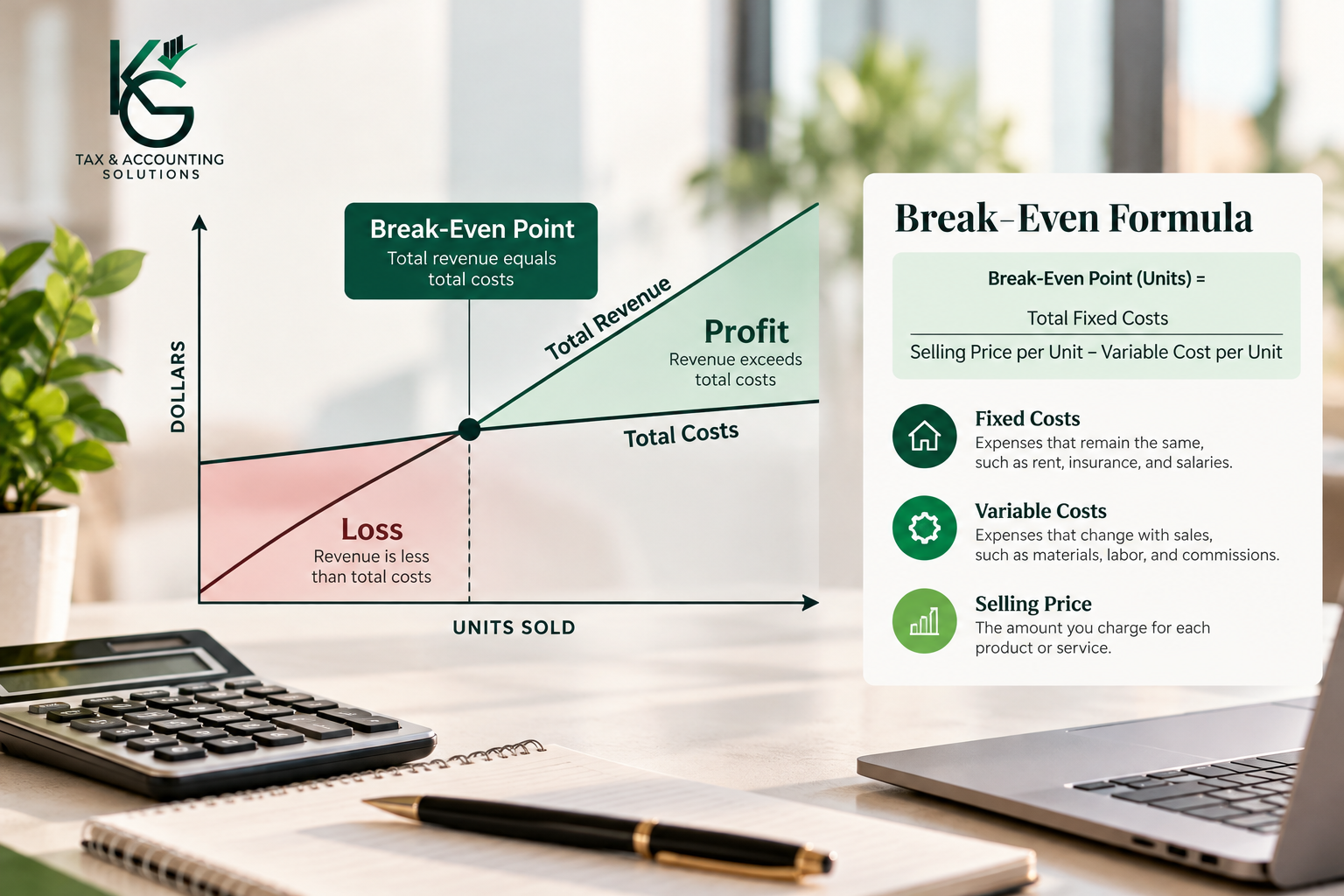
The basic break-even formula for a business selling one product is:
Break-Even Point (Units) = Total Fixed Costs ÷ (Selling Price per Unit − Variable Cost per Unit)
The difference between your selling price and variable cost is called your contribution margin per unit. This represents how much each sale contributes toward covering fixed expenses and eventually generating profit.
Break-Even Calculation Example
Suppose your business has the following monthly financial figures:
Fixed Costs: $10,000
Selling Price per Unit: $200
Variable Cost per Unit: $80
First, calculate your contribution margin:
$200 − $80 = $120
Next, divide your fixed costs by your contribution margin:
$10,000 ÷ $120 = 83.33 units
In this example, your business must sell at least 84 units per month to cover its modeled costs. That represents approximately $16,800 in monthly revenue.
Sales beyond that threshold begin contributing to operating profit, assuming prices and costs remain consistent.
For businesses offering multiple products or services, the calculation becomes more complex because each offering may have a different contribution margin. A weighted-average contribution margin can help establish a company-wide break-even target.
Why Your Break-Even Point Changes as Your Business Grows
Your break-even point is not a permanent number. It changes as your expenses, pricing, and operations evolve.
Hiring additional employees, purchasing equipment, increasing rent, or investing in new technology can raise your fixed costs. Meanwhile, changes in supplier pricing, labor expenses, or sales commissions can affect your variable costs.
For example, hiring another employee may increase monthly expenses but also allow your business to serve more customers. The important question is whether the additional revenue and contribution margin justify the investment.
Before committing to major expenses, review our guide on how to know if your business can afford to grow.
How to Use Break-Even Analysis to Improve Profitability
Calculating your break-even point is only the beginning. The real value comes from using that information to guide business decisions.
1. Evaluate Your Pricing Strategy
If your break-even target requires an unrealistic sales volume, your pricing may need attention.
Increasing prices can improve contribution margins, provided customer demand remains strong enough to support the change. Evaluate pricing alongside customer expectations, competitor positioning, and service delivery costs.
2. Identify Opportunities to Reduce Expenses
Reviewing fixed and variable costs can reveal opportunities to improve profitability.
You might identify unused software subscriptions, inefficient processes, unnecessary overhead, or supplier contracts that need renegotiation.
Reducing expenses without sacrificing service quality can lower the revenue required to break even.
3. Establish Realistic Revenue Targets
Your break-even point provides a financial baseline for setting sales goals.
Instead of choosing arbitrary revenue targets, you can determine how much sales activity is necessary to cover expenses and support your desired profit.
These calculations become even more valuable when incorporated into financial forecasting for small businesses, allowing you to anticipate changing costs and revenue needs.
4. Evaluate New Business Investments
Before hiring, expanding, or launching a new service, calculate how the decision could affect your break-even point.
An investment that increases expenses may still make financial sense if it generates sufficient additional contribution margin or improves long-term efficiency.
Common Break-Even Analysis Mistakes
Break-even analysis is useful, but its accuracy depends on the information behind it.
Common mistakes include overlooking expenses, misclassifying fixed and variable costs, assuming sales volume will remain constant after price changes, and relying on outdated financial data.
Another important consideration is cash flow.
A business can reach its accounting break-even point and still experience cash shortages because of delayed customer payments, debt principal payments, or major purchases.
That is why break-even analysis should complement, rather than replace, cash flow forecasting and broader financial planning.
How a Fractional CFO Helps Businesses Improve Profitability
Many business owners understand their revenue but lack a clear picture of how individual expenses, pricing decisions, and operational changes affect profitability.
A Fractional CFO helps turn financial information into actionable business strategy.
Through Fractional CFO and financial planning services, K.G. Tax & Accounting Solutions helps businesses evaluate financial performance, develop forecasts, monitor important metrics, and make informed growth decisions.
Rather than simply identifying your break-even point, CFO-level guidance helps you understand what influences that number and which adjustments could strengthen your financial position.
Make More Profitable Business Decisions With K.G. Tax & Accounting Solutions
Understanding your break-even point gives you a clearer picture of what your business needs to earn, where expenses may be creating pressure, and how financial decisions affect profitability.
However, sustainable growth requires more than a single calculation. It requires ongoing financial visibility, realistic planning, and a strategy built around your business goals.
K.G. Tax & Accounting Solutions provides Fractional CFO services to help business owners better understand their numbers and make confident financial decisions.
Ready to take a more strategic approach to profitability? Visit K.G. Tax & Accounting Solutions to learn how our Fractional CFO and financial planning services can support your business.

Reliable Tax & Financial Solutions for a Secure Future, Start Today!
We are committed to providing trusted, expert-driven tax and financial solutions designed to secure your financial future.
Client reviews
How We’ve Helped Our Clients
Absolutely phenomenal service! I came to Keesha with a daunting $23,000 tax liability, and through her expertise, attention to detail, and strategic approach, she reduced it to zero. I was blown away by her professionalism, clear communication, and commitment to getting the best possible outcome for me. Keesha explained everything in a way I could understand, found deductions and credits I never knew I qualified for, and handled the process with confidence and integrity. If you want results, honesty, and true tax expertise, this is the firm you need. Highly recommend to anyone serious about saving money! I recommend anyone/everyone in business to get the tax planning assessment!!!!

Mrs. Keesha is the tax GOAT! She is very professional and went above and beyond for my husband and I. I promise you, you can not go wrong using K.G. Tax & Accounting Solutions for all your tax and business needs.

I’m so happy to have found you online by searching for a tax preparation and professional lady. You helped me in more ways than one. I give you five stars.

K.G did my taxes this year and I was fully satisfied! She was able to get my taxes done within a week. I reached out to her thinking I would need to file an extension but she told me that we would meet the deadline and we did! Very professional, efficient and pleasant. I would recommend.

Mrs. Ezell has been doing my taxes for several years. She is professional, knowledgeable, prompt and affordable. I am very satisfied with her service.

For those seeking reliable tax services or an accountant, K.G Tax & Accounting Solutions is highly recommended. They keep abreast of tax laws, ensuring that detailed information is always available. The customer service and the depth of knowledge they provided to my husband and me were especially noteworthy. Having a dependable partner is crucial for financial management. As a small business owner, it's important to have someone who grasps the financial dos and don'ts for your business and can assist in optimizing all aspects for financial success. Their professionalism and tax expertise are outstanding! Mr. & Mrs. Carter

Transparency Review- my taxes was a “MESS” not a little one either a “BIG MESS” I absolutely love Keesha she saves my life every year and helps me move my business in a positive direction 🥰. Goes above and beyond all year round not just tax time. Very down to earth and knowledgeable.…

Reliable. Transparent and Personable. Well use again!




Join Our Mailing List
Subscribe for timely tax reminders, money tips, and exclusive discounts on our digital tools.
frequently asked questions
Find Quick Answers
Do you file federal and state tax returns?
Yes! We prepare federal and state returns. Multi-state filings are supported; fees apply for state-specific filings.
Are you licensed/insured?
Our staff includes experienced accounting professionals and we carry professional liability coverage.
How do I upload my documents?
Use our secure app or Google Form. You’ll receive a secure link after booking.
What payment methods do you accept?
We accept major credit cards, ACH transfers, and business checks.
What if I need ongoing support?
Choose from our Essential, Growth, or Elite packages, or request a custom engagement.
Read Our Blog


Quick Links
Resources
Legal
Connect With Us
Follow Us


© Copyright 2026. K.G. Tax & Accounting Solutions - All Rights Reserved