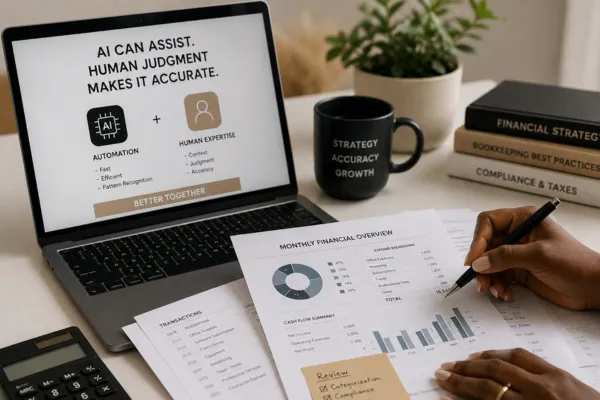
AI Bookkeeping Tools Are Powerful, But They Cannot Replace Human Judgment
Artificial intelligence is quickly becoming a part of everyday business operations, and bookkeeping is no exception. More business owners are exploring AI-powered accounting and bookkeeping tools to help streamline financial tasks, reduce manual work, and improve efficiency.
There is no doubt that AI can be a valuable tool when used correctly. It can save time, automate repetitive processes, and help businesses stay more organized. However, there is an important reality every business owner should understand:
AI can recognize patterns, but it cannot fully understand financial intent, business context, or compliance requirements.
That is why successful businesses view AI as a tool that supports bookkeeping, not as a complete replacement for professional oversight.
Where AI Can Help in Bookkeeping
AI-powered bookkeeping tools can be highly effective for routine and repetitive tasks such as:
Speeding up data entry
Reducing manual bookkeeping work
Organizing recurring transactions
Identifying vendor patterns
Suggesting expense categories
Applying bookkeeping rules based on historical data
Improving efficiency in financial workflows
These capabilities can help business owners save time and reduce administrative burdens, especially when managing large volumes of transactions.
The Limitation of AI: It Cannot Always Understand Intent
The biggest challenge with automated bookkeeping is that financial transactions often require context.
AI may correctly identify a transaction from a vendor, but it cannot always determine the true purpose behind the purchase.
For example, the same transaction could represent:
Office supplies
Business equipment
Inventory purchases
Software subscriptions
Client entertainment
Employee reimbursements
Capital assets
Each of these categories may require different accounting treatment, reporting requirements, and tax considerations.
AI can recognize the transaction. It cannot always understand the intent behind it.
Why Human Review Still Matters
An experienced bookkeeper looks beyond the vendor name and transaction amount.
They evaluate:
The purpose of the purchase
The business reason behind the expense
Tax implications
Compliance requirements
Proper categorization
Long-term financial impact
This level of analysis requires professional judgment that automated systems simply cannot replicate.
Areas Where Human Expertise Is Essential
Some aspects of bookkeeping and accounting require more than pattern recognition.
These areas often require professional review and decision-making:
Sales tax compliance
1099 reporting
Payroll compliance
Revenue recognition
Class and location tracking
Construction accounting requirements
Prepaid expense treatment
Capitalization rules
Financial reporting accuracy
Tax planning decisions
These are not just bookkeeping tasks. They involve interpretation, compliance, and financial strategy.
The Best Approach: AI Plus Professional Oversight
Rather than choosing between automation and human expertise, the most effective approach combines both.
AI can handle repetitive tasks and improve efficiency while experienced professionals provide:
Financial oversight
Strategic guidance
Compliance monitoring
Quality control
Accurate reporting
Business-specific decision making
When used together, businesses benefit from both speed and accuracy.
Questions to Ask Before Relying on Automation
If your business uses AI bookkeeping tools, consider the following questions:
Who reviews the transactions for accuracy
How are unusual transactions handled
Who ensures compliance with tax requirements
How are reporting errors identified
What process exists for correcting miscategorized expenses
Who evaluates the financial impact of bookkeeping decisions
These questions help ensure automation is supporting your business rather than creating hidden risks.
Final Thoughts
AI is transforming the bookkeeping industry and creating exciting opportunities for businesses to operate more efficiently. However, automation works best when combined with human expertise and financial oversight.
Technology can help organize information, but financial decision-making still requires judgment, experience, and an understanding of how accounting rules apply to your specific business.
If you need help cleaning up your books, reviewing your financial records, or creating stronger bookkeeping systems, KG Tax & Accounting Solutions can help you build a process that combines efficiency, accuracy, and financial confidence.


